News
Atlassian Team Europe 2026: the future of Atlassian adoption still belongs to human teams

Earlier this month, we flew to Amsterdam with one line printed across our booth:
"Bring more teams into Jira and Confluence: Marketing, HR, Operations, Procurement, Internal comms, and more."
It was great to see how many people connected with the message and had stories of their own to share. What they described over those three days was the same shift seen from a lot of different angles. More work is moving into Atlassian, but not all teams experience that move in the same way. Jira, Jira Service Management and Confluence are no longer used only by IT, software and delivery teams. They are becoming the daily workplace for HR, internal communications, procurement, operations, documentation, finance, facilities and many other non-technical teams.
The conversations went beyond the usual talk about AI and what's new in Atlassian. People shared specific challenges, from keeping knowledge reliable and making assets easier to find to helping employees navigate Confluence and understand company terminology, all while giving business teams a better experience without adding another platform.
Those questions are the reason Caelor exists. Atlassian can become the digital workplace where people find knowledge, request what they need, understand company language, and stay connected across teams. But this only works if the platform feels familiar, clear, and useful to the people who now depend on it every day.
Atlassian is becoming the workplace for more than IT
For many enterprises, Atlassian is now too important to remain a specialist environment. Confluence holds policies, onboarding pages, project documentation, product knowledge, and leadership updates. Jira Service Management handles requests, approvals, and service experiences far beyond IT. Assets can represent hardware, laptops, software licences, facilities, vehicles, internal products, and billable services.
The problem is that putting the work somewhere doesn’t mean people take to it. When non-technical teams arrive in Atlassian, they bring habits built elsewhere by intranets, online shops, employee portals, and the consumer tools they use every day. They expect to browse, read, request, and understand without learning admin logic first.
That gap is not about making enterprise software prettier. It is about reducing the effort it takes to get something done. If people can't find the right page, understand the vocabulary, recognise what matters on a page or request the right asset, then all that capability sits there unused.
Closing that gap is the work we signed up for at Caelor. Not by moving people out of Atlassian into something friendlier, but by bringing the patterns they already know into it: a front door to content instead of a search box, a catalogue for requesting instead of a form, a page you can scan and act on instead of a wall of text. Meanwhile, the system: permissions, structure, and source of truth remains governed exactly as before.
AI makes the human layer more important, not less
Team '26 Europe was, naturally, full of AI conversations: agents, how they will work across Jira, Confluence and connected tools, and what that means for everyday work.
Our takeaway wasn't that agents replace people. It's that agents depend on the same human-readable foundation people do.
An agent can only act on the context it can reach and understand. That context still has to be created, named, governed, and maintained by people: pages, decisions, process explanations, service catalogues, asset records. A human signs off before an agent runs a plan, and decides what it is allowed to see. A context graph is only ever as good as what people actually wrote down. If your knowledge is confusing for employees today, it will be confusing raw material for AI tomorrow.
What we heard again and again is that people want the easier, more intuitive experience AI promises, but not at the cost of governance, security, or control. That is the same balance we work on every day.
Customers want more visibility without losing control
The most recurring topic across Team26 conversations was that everyone wants to keep more work inside Atlassian, but they need better ways to make that work understandable and manageable for different teams and roles.
For asset and service-management teams, this means delegated ownership, granular permissions, audit workflows, and visibility without turning every regional or business owner into a Jira Assets admin. It also means being realistic about where data actually lives. Asset information is often scattered across spreadsheets, external systems, mature ServiceNow environments, and existing Jira Assets models. A rip-and-replace pitch doesn't fit that reality. A layer that makes what is already there visible and requestable usually does.
For Confluence-heavy teams, the pattern is similar. Customers asked for stronger navigation, authoritative content discovery, better handling of large document volumes, and clearer content lifecycles. Nobody wants another place for knowledge to drift. They want the knowledge already in Confluence to become easier to trust, find, and use.
Assets are about much more than laptops and hardware
Asset and catalogue conversations shouldn't be limited to laptops, monitors and peripherals anymore. Those are easy starting points, but the market is much wider: software licences and subscriptions, internal products, vehicles, facilities and rooms, tools and equipment, etc.
And the wider that catalogue gets, the less likely it is that the person who needs something is the person who administers it. A designer needs a licence, a site manager needs equipment for a crew, someone starting Monday needs a desk and a laptop and three logins. Getting any of it still means a ticket, or asking someone who knows.
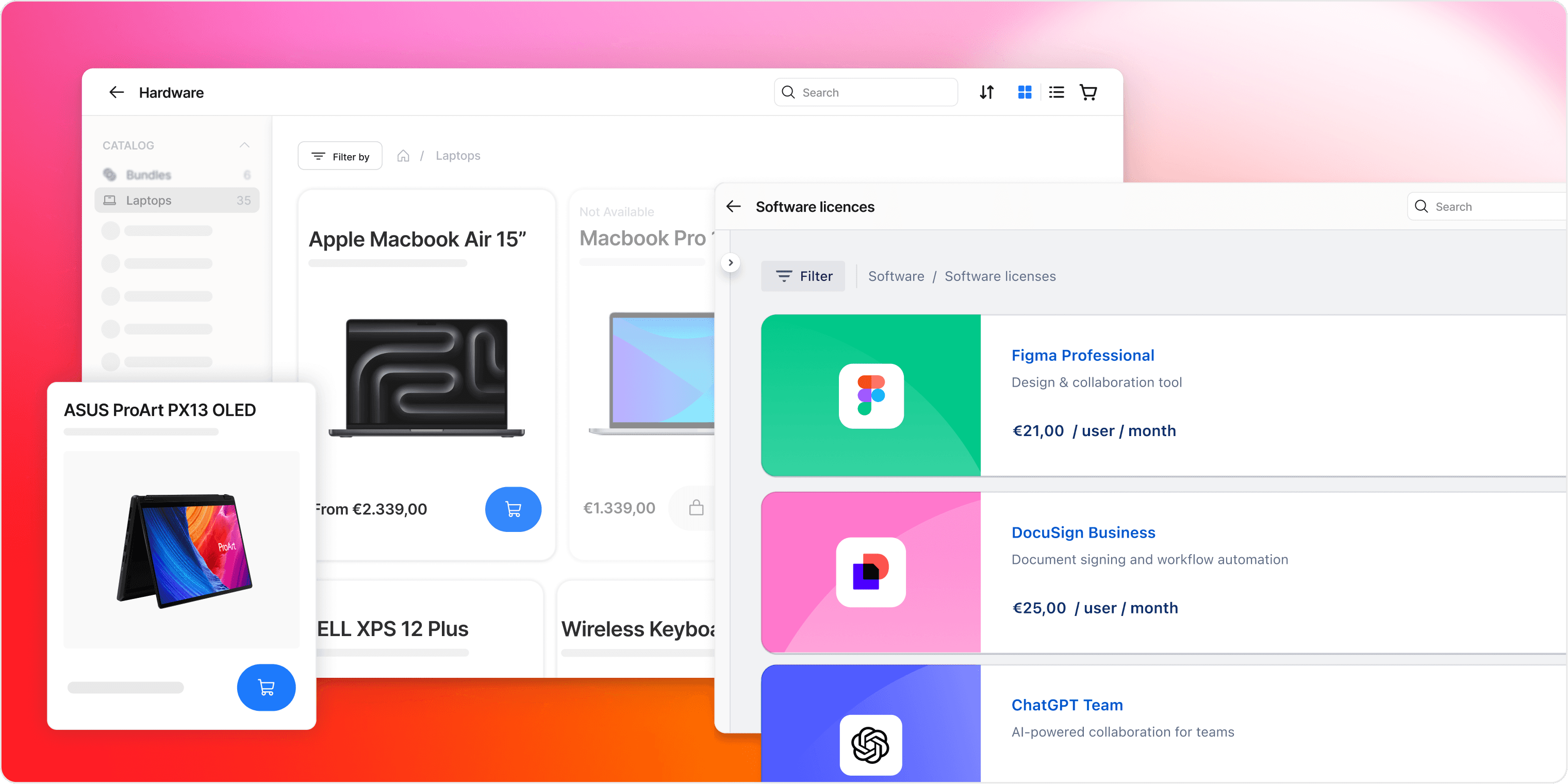
That's how Shoppie, our shopping catalogue app, came about. It turns what's already in Assets into a catalogue people browse and order from. Nobody needs to know what an object schema is, and requests still run through Jira Service Management with the approvals already in place, while Assets stays the source of truth.
Confluence adoption depends on navigation, language and readability
Companies are pushing Confluence to act as an intranet, documentation hub, onboarding centre, knowledge base and communication channel all at once. That is a lot to ask of a system that many employees still experience as a maze of spaces, sidebars and long pages.
Whether that works comes down to three things, none of which are about how much content is in there. People need somewhere obvious to start, because a search box only helps you if you already know what you’re looking for. The shape of a page decides whether anyone gets to the end of it or skims to the part that concerns them. And a company language has to be understandable, because an acronym or a renamed project that is perfectly clear inside one department becomes a small obstacle every time it reaches anybody else.
What struck us is that customers don't experience any of this app by app. They experience it as a journey: joining a company, finding the right policy, requesting the right service, working out what a term means, or getting a change across to everyone it affects.
And this can’t be solved by adding more content or context. We do it by giving Confluence a front page that shows what is actually going on in the company, letting authors build from patterns that are already readable instead of starting in an empty editor, and explaining terminology at the moment somebody reads it rather than in a page they would have to go looking for. Those changes make Confluence somewhere people go for their everyday work, instead of another system they have to figure out.

Migration is a moment of truth for Atlassian-centred workplaces
Migrations are happening in both directions: Data Center to Cloud, and work moving out of external tools into Jira and Confluence for the first time.
When a company migrates, it isn't only moving content or workflows. It is deciding what employees will consider a new “home” for their work. People come with habits, with things they relied on, and with a way of working they stopped thinking about years ago. When a capability they used every day disappears, when the new version takes more effort than the old one, or when what they knew doesn't make it across, adoption drops quietly and without anyone raising it as a problem.
That's why the companies who do this well use the move to improve how work feels, not only where it lives. This is the best possible moment to rethink employee experience and fix the problems people were already working around, instead of rebuilding them somewhere new.
Partners are looking for solutions, not products
Solution partners see a side of all this that most vendors don't. They meet these problems across migrations, intranets, service management, knowledge governance and enablement, often at several companies at once. And what came through clearly is that a partner doesn't want to pitch “another Confluence app”. They want a credible way to help a customer replace an ageing intranet, improve asset visibility, build an onboarding experience, bring terminology under control, or make Confluence work for a much wider group of employees.
That tells us something about where the ecosystem is heading. It is maturing around outcomes rather than Marketplace listings. Conversations start with the business moment now, rather than the product.
Our takeaway: make Atlassian clearer for humans first
Atlassian keeps taking on more of everyday work, and nearly every problem we heard about came back to the same thing. People couldn't tell what was where, what it meant, who owned it, or how to ask for it.
That's what our apps are built for. Not a collection of Jira and Confluence add-ons, but a way to make work feel more familiar, clear and connected for every team: an intranet experience inside Confluence with Cosmos, service requests and asset visibility with Shoppie and Radar, and shared language with Glossary.
The reason that combination matters is that these two things usually come apart. A workplace that feels good to use, and a system that stays properly controlled. Employees get something they can navigate without training. Admins and platform owners keep the structure, permissions and source of truth they need. And as AI becomes more present at work, agents get better context, because the people around them have a better way of creating and maintaining it.
In other words: the future of Atlassian adoption is not only agentic. It's human-centred. The companies that make their digital workplace legible to people will also make it more useful for every system working beside them.
